



A Complete Guide to Digital Marketing Strategy for Indian Startups
Startups encounter unique opportunities and challenges when establishing their market presence in
India’s rapidly evolving digital landscape. Many start-up companies have benefited from our
assistance at Strat360 in transforming their digital presence into a powerful engine for growth. This
in-depth manual will help you develop a successful digital marketing strategy tailored specifically to
the Indian startup ecosystem. | Guide to Digital Marketing Strategy
Recognizing the 2025 Indian Startup Ecosystem
Over the past ten years, the Indian startup ecosystem has grown significantly, ranking third in the
world. India’s digital economy is expected to grow to $1 trillion by 2026, with over 100,000 startups
already registered. However, this rapid expansion also means increased competition for audience
attention, making a strategic approach to digital marketing even more important.
It is crucial for Indian startups to comprehend the unique characteristics of the local market. India
offers a distinct demographic mix compared to Western markets, including a youthful
population—with more than 65 percent under the age of 35. Regional differences in linguistic
preferences, along with varying levels of digital literacy and internet penetration, also play a role.
Consumers balance price sensitivity with expectations for quality. Community and family have a
significant impact on purchasing decisions.
Rather than simply applying global strategies, these factors require you to customise your digital
marketing approach for the Indian audience.
Establishing Your Base: Crucial Elements of a Guide to Digital Marketing Strategy
1. Establish Your Positioning and Brand Identity
Startups need to develop a distinct brand identity that resonates with their target market before
launching tactical marketing campaigns. This includes:
Value Proposition : What specific problem does your solution solve?
Brand Voice : How does your company communicate with its target audience?
Visual Identity : How does your brand look?
Brand Story : What compelling story forms the foundation of your company?
At Strat360, we’ve noticed that new businesses frequently dive right into marketing initiatives without
establishing these core components. Usually, this oversight results in diluted market impact and
inconsistent messaging.
2. Audience segmentation and market research
The first step in successful digital marketing is conducting in-depth market research to comprehend:
The Target Audience Demographics: Location, age, education, and income level
Psychographics : Lifestyle, interests, values, and pain points
Digital Behaviour : Preferred platforms, content consumption habits, and purchasing decision process.
>Analysis of Competitors : Positioning, digital tactics, strengths, and weaknesses
We advise Indian startups to develop thorough buyer personas that take regional quirks into
consideration. For instance, advertising tactics that are effective in cities such as for tier-2 and tier-3
cities, Mumbai or Bangalore might require considerable adaptation.
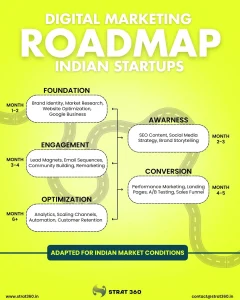
3. Establishing Specific, Measurable Goals
Every effective digital marketing plan is based on well-defined goals. These often includes:
Visibility : Increasing awareness of the brand among the target audience.
>Lead generation: Collecting data on potential customers.
>Conversion Rate : Increasing the proportion of leads that turn into paying customers
Customer Retention : Increasing their loyalty and repeat business
Return on Investment (ROI) : Assessing how well marketing expenditures are working
Your goals will give you clear direction and accountability if you follow the SMART framework
(Specific, Measurable, Achievable, Relevant, Time-bound).
Strategies Particular to Channels for Indian Startups
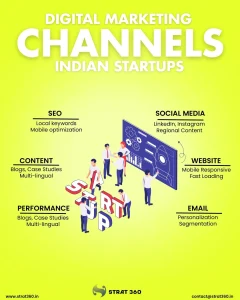
1. SEO, or search engine optimization
Local SEO is especially crucial for Indian startups. Pay attention to:
Local Search Terms : Use keywords that are specific to a given location, such as “digital marketing
services in Delhi NCR.”
>Google My Business : Keep an up-to-date and comprehensive Google Business Profile
Optimising for Mobile : Since mobile devices are used by more than 70% of Indian internet users,
make sure your website is fully responsive.
Optimising Voice Search : Adjust your strategy to include voice search queries in multiple Indian
languages.
Technical SEO : Ensure your site is mobile-friendly, use proper schema markup, and improve site
speed.
Your content should cater to your Indian audience’s particular requirements and search habits. If
there are segments of your target market that do not speak English, think about producing content in
regional languages.
2. Marketing on Social Media
Startups should take advantage of the distinctive features of social media usage in India:
LinkedIn
With more than 95 million Indian users, LinkedIn offers B2B startups outstanding prospects. Our
strategy consists of:
Content for Thought Leadership : establishing the founders and important team members as
authorities in the field.
>Employee Advocacy : Expanding reach through team networks
Industry-Specific Organizations : Participating in pertinent professional networks
Creating articles on LinkedIn directly to increase visibility is known as “native content.”
>Developing connections with possible customers, partners, and investors is known as strategic
networking.
>Instagram
Instagram is crucial for B2C startups aiming to reach younger audiences:
Making captivating visual narratives about your brand is known as visual storytelling.
>Influencer Partnerships : Joining forces with pertinent micro and macro influencers
Instagram Shopping : Making use of e-commerce tools to increase direct sales
Using short-form video content to increase engagement with reels and stories
Location Tags: Reaching local audiences with location-specific features
3. Marketing Content
In digital marketing, content is still king, particularly for startups building credibility:
Blog Strategy: Consistently posting educational, search engine optimised content
Case Studies: Illustrating effective client changes
E-books and Whitepapers: Creating gated content to generate leads.
>Organising workshops and webinars to educate your target audience
Podcasts: Taking into account audio content to reach major Indian cities’ commuters Make sure your
content speaks to the particular difficulties your Indian target audience faces. Higher engagement will
result from localised content that makes reference to well-known situations, examples, and problems.
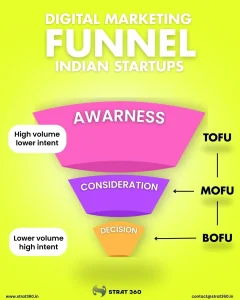
4. Marketing Performance
Performance marketing provides quantifiable outcomes for startups with limited funding:
Google Ads: Focussing on Indian market-specific high-intent keywords
Campaigns for Remarketing: interacting with consumers who have already dealt with your brand
Programmatic Advertising: Effectively reaching particular audience segments
Social media advertising: Creating highly targeted campaigns on the platforms where your audience
is most active.
>When putting performance marketing into practice in India, take into account:
Channel-wise Budget Allocation: Distribute resources based on where your audience is most active.
>Regional Targeting: Tailoring advertisements to various locales and dialects
Mobile-First Strategy: Making ads more mobile-friendly
A/B Testing: Constantly evaluating various ad creatives and messaging
5. Email Promotion
Email marketing still yields a high return on investment for Indian startups, even with the emergence
of newer channels:
Segmenting your audience according to their behaviour, interests, and stage of the customer journey
is known as segmentation.
- Personalisation: Tailoring information according to user preferences and data
- Automation: Putting behavioural triggers and drip campaigns into action
- Mobile Optimisation: Ensuring emails display correctly on all mobile devices.
- Analytics: Monitoring conversions, click-through rates, and open rates
- Assessing Achievement: Analysis and Enhancement
Just putting it into practice is half the fight. It is essential to continuously measure and optimise: - Web Analytics: Use Google Analytics to set up thorough tracking.
- Conversion tracking: Monitor actions that lead to sales conversions.
Determine which channels generate the most value using attribution modelling. - Benchmarking of competitors: Evaluate performance in relation to industry norms.
- Frequent Reporting: Produce organised reports to monitor goals and progress.
Allocating Funds to Indian Startups Strategic budget allocation is essential for startups with limited
funding: - The 80/20 Principle: Allocate 80% of your resources to the channels that deliver the highest returns.
- Scale and Test Model: Make modest initial investments, track your progress, and then expand your
successful projects. Seasonal Modifications: Set aside extra funds for your industry’s peak seasons. - Cost-Benefit Analysis: Regularly evaluate channel performance and reallocate as needed
Typical Mistakes Indian Startups Should Steer Clear of We’ve found common errors in our experience working with many Indian startups:
Platform Overextension: Trying to manage too many channels simultaneously.
>Ignoring Data: Making choices based on presumptions as opposed to analytics.
>Inconsistent Branding: Failing to maintain cohesive messaging across channels.
>Short-Term Focus: Giving priority to short-term outcomes over creating long-term digital assets.
>Case Study: How Strat360 Changed the Online Presence of an Indian Tech Startup Despite having a
cutting-edge product, one of our clients, a Bangalore-based B2B SaaS startup, approached us with
little online presence. Using our all-encompassing digital marketing strategy, we positioned the
founders as thought leaders on LinkedIn, put into practice a focused SEO strategy with an emphasis
on keywords unique to the industry, created case studies that showcased their unique selling
proposition, developed a performance marketing campaign aimed at their niche’s decision-makers.
In just six months, they achieved:
- 300% more qualified leads
- 150% increase in organic traffic
- 40% lower customer acquisition cost
Conclusion to a Guide to Digital Marketing Strategy
In summary: Developing a Digital Strategy that is sustainable is about creating a long-term
competitive advantage for Indian startups, not just about making quick money. Instead of seeing
digital marketing as a cost, the most prosperous startups see it as a strategic investment. At Strat360, we collaborate with innovative startups to create all-encompassing digital marketing plans that are
suited to the particular opportunities and difficulties of the Indian market. Our integrated strategy
guarantees that every digital touchpoint contributes to your company’s goals.
The correct approach can greatly quicken your growth trajectory, regardless of whether you’re starting
a business or trying to scale your current digital initiatives. Keep in mind that in today’s digital-first
world, your company’s online presence often serves as the first impression for prospective clients,
partners, and investors. Are you prepared to change the way your startup uses digital marketing? To
find out how our 360-degree digital marketing solutions can help your company succeed in the
cutthroat Indian market, get in touch with our team for a free consultation.